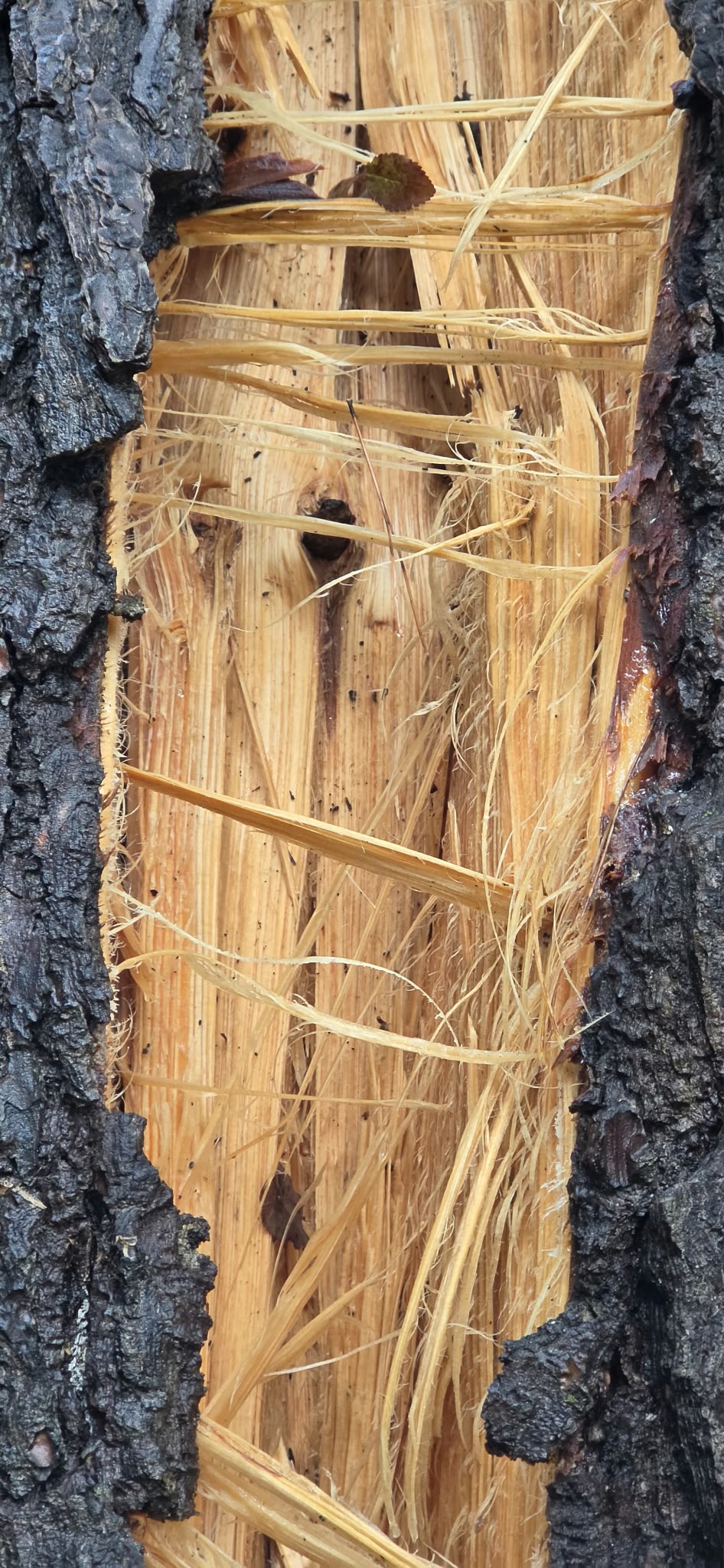
Spontaneitas began with the image of a tree split during a storm. Between the dark edges of the bark, the exposed wood reveals golden hues and loose fibres stretching across the opening in unexpected directions. What had remained hidden within the unbroken trunk suddenly becomes visible, in a configuration that brings together the slow unfolding of growth and the traces of a violent event. Seen up close, the split offers a glimpse into the tree’s inner material structure: the way its fibres supported and extended into one another before those connections were torn apart.
The force of this image also lies in the ambiguity with which it meets the eye. We recognise the torn wood, yet our attention is held by the brightness within, the delicacy of the filaments and the rhythm they create above the open hollow. Fragility and resilience coexist on the same surface, as do the continuity of growth and its interruption. Attention gradually shifts from what happened to the tree towards the visual relationships the event has made possible. In this shift, the possibility of a painting begins to emerge.
The Kantian sense of spontaneity offers a way of understanding this passage. In the Critique of Pure Reason, Kant distinguishes the receptivity of sensibility, through which objects are given to us, from the spontaneity of the understanding, through which they are thought. Knowledge requires these two faculties to meet: we are affected by what presents itself to us, while the understanding plays an active part in organising experience through concepts. Spontaneity here names an activity belonging to the faculty of cognition, whose meaning extends beyond the everyday sense of an immediate, unpremeditated gesture.
For a reflection on painting, this distinction is fruitful because it allows us to preserve both dimensions of the encounter with an image. First, something commands attention through its presence: the particular character of this tree, the contrast between bark and wood, the tension of the fibres still stretched between the edges of the split. The experience has a concrete starting point that surprises the artist and directs their attention. From there, the painting develops through a succession of relationships that are explored, retained or transformed, as the memory of the image meets the possibilities of colour and material.
The connection with Kant should be understood as an interpretation of this process, mindful of the difference between a theory of knowledge and a reflection on an artwork. Kant’s analysis concerns the conditions under which we can know objects; it does not directly describe how a painting comes into being. Yet the idea that the subject actively contributes to connecting representations offers a way of thinking about the distance between an impression received and an image developed. For Kant, what we receive through the senses also involves an activity of the mind, which connects representations and brings them together within a coherent experience. This active participation gives us a starting point for reflecting on the passage from an encountered image to pictorial form.
From this perspective, we can consider the making of pictorial form as an activity in which the elements of an experience enter into new relationships. The direction of a fibre, the light on a surface or the depth of a fissure acquires a value in painting that depends on the whole into which it is brought. A line may retain the memory of wood while also sustaining the movement of the composition; a hue drawn from the initial image may gain intensity beside another colour. The unity of the work takes shape through these relationships, in a process in which perception is continually revisited and transformed.
The photograph of the split tree makes this passage particularly tangible because it already offers the eye a complex structure that cannot be exhausted by recognising the object. We know what we are looking at, yet we can linger over the image, following the way the fibres cross the opening or the bright interior stands out against the dark bark. This sustained attention prepares a departure from the original motif: the relationships observed can be taken up on canvas, where they find different proportions, different tensions and a different material presence.
Seen in this light, the title Spontaneitas finds its connection with Kant’s thought in the activity of the subject who receives and works with experience. The splitting of the tree belongs to the order of natural causes; its pictorial significance takes shape in the encounter between what the image offers and what the artist makes possible through it. We can thus preserve the full force of the event without attributing an intention to the tree or turning the split into a manifestation of freedom.
The tree remains the concrete origin of the work, with its singular character and vulnerability. Yet this encounter opens a path along which the form seen becomes a form sought, and what first held the eye begins to exist in the language of painting. Spontaneitas can thus be understood as the name for an active participation in our experience of the world: the capacity to receive an image and work with it until, through the relationships between colours, lines and surfaces, a distinct pictorial presence takes shape.