“The present is an interlude, a strange interlude in which we call upon the past and the future to bear witness that we are alive.” — after Eugene O’Neill, Strange Interlude, 1928
One question has followed my work for years: where is an image before it becomes gesture, colour or matter?
We do not see it directly, yet it manifests itself everywhere: in a novel, a poem, a painting, a sculpture, a musical composition, or a philosophical intuition. These forms belong to different territories, but I experience them as multiple emergences from a common source. Something that had remained invisible passes through the mind or hand of a human being and becomes sentence, colour, matter, rhythm, or concept.
The way this transformation occurs will always represent, for me, a journey through space and time—a journey of which we are rarely fully aware.
When we look at a painting, we do not remain entirely in the room where it hangs. When we read a novel or listen to an operatic aria, we silently leave the place and moment around us. We enter the author’s inner time, their mental space, the light, tensions, and memories from which the work emerged.
Then we return to our own world, the one we call real, and to what we call our present. But we never return entirely alone. We bring back fragments from another time: an image, an emotion, a sentence, or a sound that may continue to live within us without our knowing exactly how.
This mysterious movement between different times and different consciousnesses leads me to a question: what is this present to which we believe we return? Is it an autonomous instant, clearly separated from past and future? Or is it a shifting passage where what has already been lived meets what does not yet exist?
Eugene O’Neill’s description of the present as a “strange interlude” accompanies this question. In the language of literature, it expresses something neuroscience now approaches by another path: the brain never perceives a pure present. At every moment it constructs reality from traces of the past and anticipations of what may occur.
A literary intuition, a scientific light
Literature sometimes formulates an intuition whose mechanisms science will later illuminate. This does not mean that a writer anticipated a scientific theory, nor that a work of art should be reduced to a demonstration. Literature and science do not speak the same language or from the same place, but they can meet around a shared enigma.
In Strange Interlude, the present appears as a fragile interval between two dimensions that seem more substantial. The past remains through memory. The future becomes present through desire, fear, and expectation. Between them, the current moment seems almost impossible to grasp. By the time I have pronounced the word “now,” that now already belongs to the past.
Neuroscience cannot decide whether the present exists in a metaphysical sense. It can, however, study how the brain produces the conscious experience we call the present. What it discovers makes this moment stranger than it appears.
The present we experience is not an instantaneous photograph of the world. It is a composition. The brain brings together information that does not arrive simultaneously, interprets it through previous experience, and anticipates its likely development. Our present therefore contains what has just disappeared and what has not yet happened. It is not a motionless point: it is a process.
Seeing is not passive
We spontaneously imagine perception as a transparent window. Yet the nervous system never receives an already composed image. It receives variations in light, vibrations, pressures, and chemical signals—partial and sometimes ambiguous. The brain must select them, connect them, and assign them a probable cause.
To see is already to interpret. Recognising a face mobilises a memory of faces, learned regularities, a context, and sometimes an emotion. A partly hidden form appears continuous because experience has taught us that objects do not cease to exist when they are concealed.
The past is therefore not confined to autobiographical memory. It acts silently in the way we perceive the current world. Before a painting, we never look with virgin eyes. We arrive with a history, previously encountered images, emotions, and largely unconscious associations. The work appears in the present, but our gaze comes from far away.
The predictive brain
One of the most influential families of theories in contemporary neuroscience is predictive processing. According to these models, the brain does not passively await sensory information. It continually develops hypotheses about its possible causes.
Higher levels of perceptual systems are proposed to send predictions towards lower levels. Incoming signals are compared with these expectations, and the difference forms a “prediction error” through which the internal model can be corrected.
In the classic model developed by Rajesh Rao and Dana Ballard, descending connections convey predictions, while ascending connections signal what was not correctly anticipated. Their model reproduced several properties observed in visual cortex. I find it fascinating that the brain may devote so much of its activity not to recording what it already knows, but to detecting what resists its expectations.
Surprise then becomes an essential moment: it reveals the meeting between our inner model and a reality that refuses to be fully enclosed within it.
The brain does not arbitrarily invent the world. Its hypotheses are continually constrained by external information. When sensory evidence is precise, it strongly corrects our expectations; when it is ambiguous, previous experience weighs more heavily. Perception is constructed in the tension between what the brain contributes and what the world opposes to it.
Imaging experiments have shown that prior expectations can influence representations of a stimulus in visual cortex. Work by Peter Kok and colleagues indicates that expectations bias neural representations towards the anticipated stimulus. Other research has found expectation-related signals in layers of primary visual cortex. Anticipation may therefore do more than comment on perception after the event: it may participate in its construction.
The word “prediction” must nevertheless be used carefully. It does not always refer to a conscious representation of the future. It can mean estimating absent or uncertain information through a model built from experience. Predictive processing remains an influential theoretical framework, not a definitive explanation of every brain function.
A slightly delayed present
Even what appears instantaneous requires time to become conscious. Light reaches the retina, is transformed into electrical activity, and is processed across several brain regions. Sound, touch, and internal signals follow different paths and do not all arrive at the same rate.
Yet we do not normally perceive a disjointed universe. The brain gathers these signals into a unified scene. That unity is itself an act of composition.
The flash-lag illusion offers a glimpse of this invisible work. Experiments by David Eagleman and Terrence Sejnowski showed that the perception attributed to the moment of a flash could be influenced by what occurred immediately afterwards. Their interpretation remains debated, but the phenomenon reveals that a conscious event is not always complete at the physical instant when we believe we perceived it.
Consciousness may live slightly behind the world while giving us the impression of simultaneity. This delay is not simply a defect: it enables the brain to construct a coherent and usable present.
Nor does the brain have a single duration of the present. Uri Hasson’s research revealed a hierarchy of temporal windows in the cortex. Some regions process rapid changes; others integrate information over longer periods in order to understand a sentence, a scene, or a narrative.
The present of a colour is not the present of a melody. A note acquires meaning only by retaining the trace of those that preceded it and awakening the expectation of those to come. Every art form therefore opens its own temporality. The work does not merely exist in time: it produces its own time.
Remembering in order to imagine
Memory is often pictured as an archive, but memories are not preserved as intact objects. To remember is already to reconstruct. We reassemble places, sensations, people, and emotions. This reconstruction explains certain distortions, yet it also allows fragments of the past to be recombined into an event that has never occurred.
Research by Daniel Schacter, Donna Rose Addis, and Randy Buckner led to the concept of the “prospective brain.” Memory may serve not only to preserve the past, but also to provide the materials required to simulate possible futures.
Brain-imaging studies show that recalling a past event and imagining a future event recruit a largely shared network, including the hippocampus and regions of the default mode network. Imagining tomorrow does not mean creating from nothing. We borrow places, faces, emotions, and narrative structures from the past in order to compose a new scene.
This idea leads me directly back to artistic creation. The artist never works with an entirely untouched inner material. Even when an image seems to arise spontaneously, it passes through a memory made of perceptions, readings, dreams, encounters, and forgotten forms. Creation does not necessarily reproduce these elements: it displaces them and makes them appear in new relationships.
The three presents of philosophy
Long before neuroscience, Augustine observed that the past is no longer, the future is not yet, and the present never ceases to pass. He proposed three modes existing within the mind: the present of the past, which is memory; the present of the present, which is attention; and the present of the future, which is expectation.
This formulation transforms the three dimensions of time into three inner movements. Neuroscience does not “prove” Augustine, but by different methods it encounters the same difficulty: our experience of the present cannot be separated from either memory or expectation.
Husserl explored this structure through the example of melody. The note that has just faded remains as retention; the current note occupies the centre of experience; and protention opens an expectation of the next. Without retention there would be no melody, only isolated sounds. Without protention there would be neither tension nor surprise.
William James used the term specious present for the brief duration experienced as immediately present. The psychological present is not the dimensionless point of mathematical time, but a window in which several moments are gathered.
Bergson, finally, contrasted the homogeneous time of clocks with lived duration. In consciousness, moments do not remain external to one another: they continue into and transform one another. I find this duration in painting. A colour added today changes the place and meaning of a colour applied yesterday. The work possesses an internal memory, inscribed in its layers, transparencies, and erasures.
The imaginary, the imaginal and another person’s time
The imaginary cannot be reduced to what is unreal. It is the power to make the absent present and to create new forms from the materials of experience. For me, the imaginal is that intermediate space where an image seems to possess its own necessity, as though it were asking to become visible.
I do not seek to assign it a cerebral location. That would confuse a philosophical notion with a biological object. Neuroscience can, however, illuminate some conditions that make its emergence possible: reconstructive memory, anticipation, the association of distant elements, and the capacity to simulate absent realities.
When an inner image becomes a painting, a poem, or music, it crosses a threshold. An invisible construction takes material form and becomes accessible to another consciousness. Something intimate leaves the artist’s interior space and enters the shared world.
When we encounter a work, several temporalities overlap: the historical time of its creation, the artist’s personal time, the material time of successive gestures, and our own time as viewers. We travel within the work without physically leaving our world, then return to our lives carrying something that was not there before.
An aria can awaken a memory believed lost. A novel can alter our understanding of a personal experience. A painting can place within us a colour that returns years later. Art makes possible a coexistence between times and consciousnesses that can no longer meet in the physical world.
Painting within the interlude
When I paint, the present gesture always responds to gestures already inscribed on the canvas. A new colour enters into dialogue with those that preceded it. An almost accidental form can divert the painting from its initial direction and open a possibility I had not imagined.
At times I sense an equilibrium that does not yet exist, but matter may contradict my anticipation. Colour resists, a line displaces the centre of the image, or a superimposition reveals an unexpected presence. I must then transform what I believed I was seeking.
Creation becomes an exchange between the memory of the work—everything already contained within it—and its still undetermined future. Sometimes the painting seems to know before I do what it may become.
I would not want to reduce this experience to a neural mechanism. The language of art cannot be replaced by the language of the brain. Neuroscience nevertheless offers another way of thinking about the dialogue between what is already there and what remains possible, between trace and prediction. It suggests that this structure lies at the heart of our way of inhabiting the world.
Returning to the strange interlude
I would not say that the present does not exist. I would say that we never meet it alone: something has just ended and something else is already expected.
The lived present is a moving construction. It preserves traces of what has just disappeared, interprets incoming signals, and already anticipates the next instant. It is strange because it cannot be immobilised. It is fragile because it is continually revised. Yet it is alive precisely because it remains open.
Perhaps art enables us to feel this openness with particular intensity. Before a painting, within a poem, or at the heart of a musical phrase, several times overlap. The artist’s past meets the viewer’s present. An old image becomes a new perception. A completed work produces a future it could not foresee.
We travel through the time and space of another consciousness and return to our own world carrying fragments of that journey.
What we call the present may be precisely this: not a boundary between what is no longer and what is not yet, but the invisible place where memory, perception, and anticipation meet to bring forth a form—a novel, a poem, a sculpture, a composition, a painting—or, for an instant, the mysterious sensation of being alive.
Scientific references
Rao & Ballard, Predictive Coding in the Visual Cortex, Nature Neuroscience, 1999.
Eagleman & Sejnowski, Motion Integration and Postdiction in Visual Awareness, Science, 2000.
Addis, Wong & Schacter, Remembering the Past and Imagining the Future, Neuropsychologia, 2007.
Schacter, Addis & Buckner, Remembering the Past to Imagine the Future, Nature Reviews Neuroscience, 2007.
Hasson et al., A Hierarchy of Temporal Receptive Windows in Human Cortex, Journal of Neuroscience, 2008.
Kok et al., Prior Expectations Bias Sensory Representations in Visual Cortex, Journal of Neuroscience, 2013.
Teufel & Fletcher, Forms of Prediction in the Nervous System, Nature Reviews Neuroscience, 2020.
Aitken et al., Prior Expectations Evoke Stimulus-Specific Activity in the Deep Layers of Primary Visual Cortex, PLOS Biology, 2020.
01
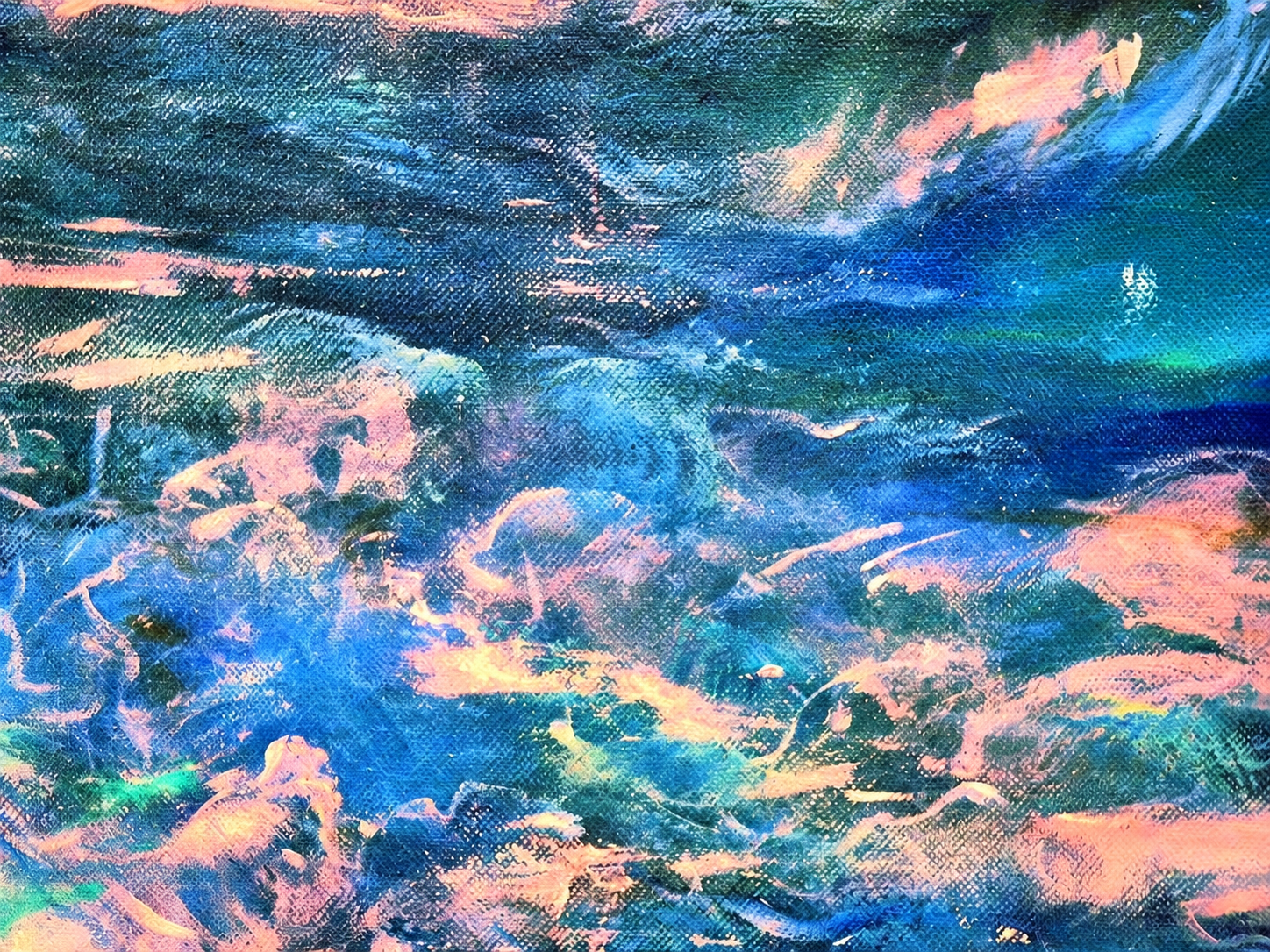
The Strange Interlude — what the brain makes of the present
Laura & Baston